Colombians Reckon with Earthquake Destruction After ‘Tangled’ Response from Officials
71-year-old Gustavo Silvino Sánchez Castro has watched Colombia rebuild after disasters before, but never like this one. As the new government falls short in responding he said, “there lies the imprint of corruption” buried in the rubble.
While Colombian families grapple with the destruction of the earthquake that struck early last month, for Gustavo Silvino Sánchez Castro, 71, this isn’t the first time he heard the crying of desperation or questioned if the earth cracking open beneath him was going to eat him alive.
In 1999, he was working as an agricultural engineer at a coffee farm in Córdoba, Quindío when suddenly he heard “a very, very loud noise.”
“When one looks up to the horizon, one sees a mushroom cloud there…” Silvino said. “It turns out that those mushroom clouds came out of the destruction of a house or a coffee processing plant.”’
At the time of this reporting, the death toll from the Aug. 10 earthquake has reached at least 331 people, with more than 4,500 injured, according to Colombia's disaster risk management agency.
The Colombian government’s response to the country’s latest earthquake has since sparked controversy about whether the response of officials was sufficient.
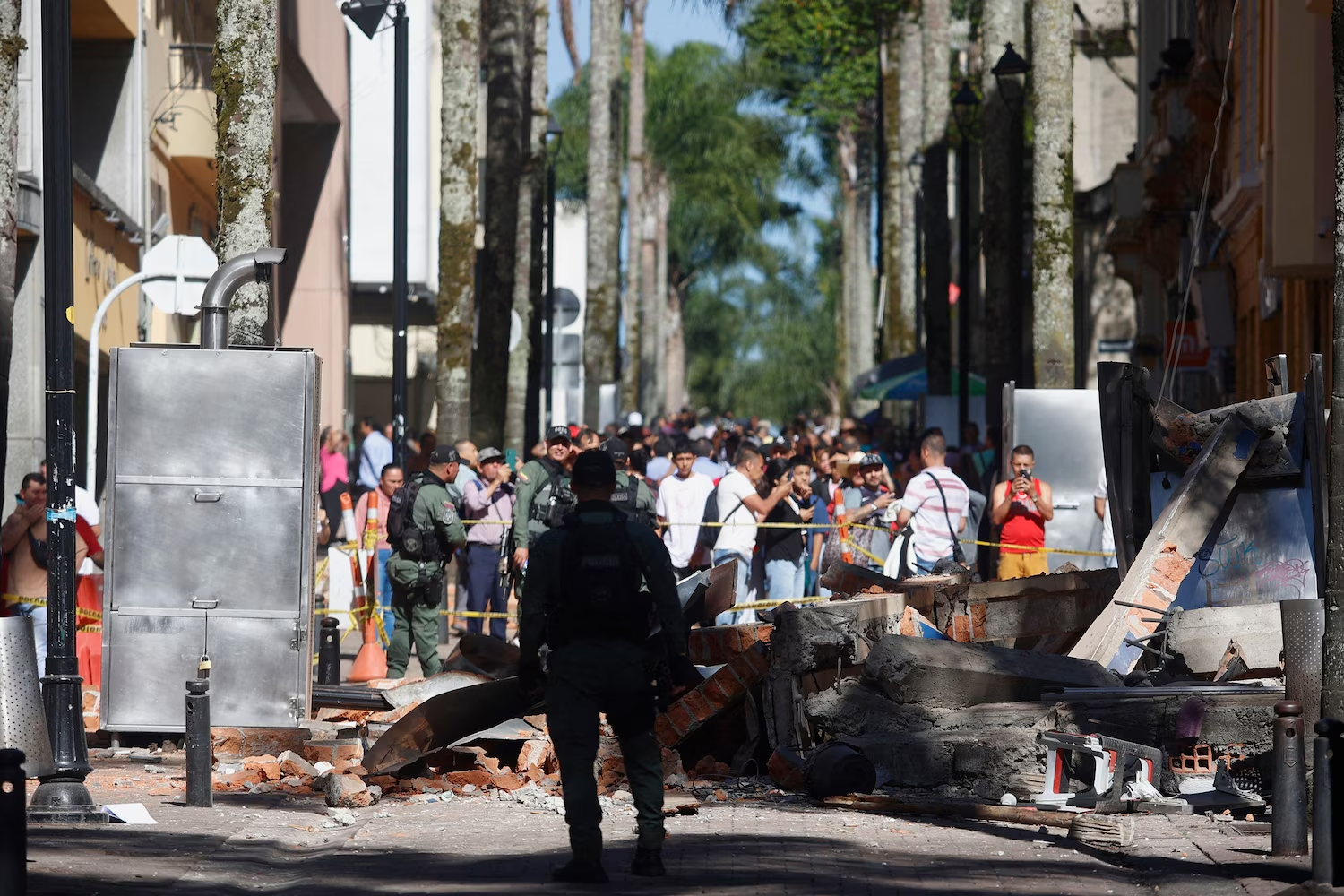
Santiago Saldarriaga/AP
A new government's first test
President Abelardo De La Espriella had only been in office for three days after defeating progressive candidate Iván Cepeda by less than 1% before the earthquake hit.
Sergio Guzmán, director and co-founder of Colombia Risk Analysis, a political risk consultancy organization based in Bogotá, said, "they were inaugurated on Friday and early on Monday is the event. There were many people who came from the previous government who continued, let's say, but they were like on vacation mode."
Guzmán said, referring to the government, “also, we should be fair” because “nobody is prepared for an event of this magnitude.”
"They did the best they could with what they had," he added.
The Colombian government received backlash after it denied entry to Mexico's search-and-rescue teams during a critical 72-hour period, when rescue teams had the statistically highest chance of finding survivors under the rubble.
Mexican President Claudia Sheinbaum said during a press conference that Colombia's government asked for the rescue teams' certification in order for them to enter the country.
"They are certified but now they are asking for another certification," she said.
Food and medical supplies sent by Mexico were still being let into Colombia, but "the rescue brigade from the Secretariat of National Defense was not approved by the Government of Colombia," Sheinbaum confirmed.
Brazil and China were among other countries that offered humanitarian aid shortly after the natural disaster.
David Santiago Tamayo Roldán, the director of Colombia's National Unit for Disaster Risk Management (UNGRD), who was sworn in two days after the earthquake, said the government would request rescue teams from only four countries: Israel, the U.S., El Salvador and Ecuador.
This acceptance of rescue teams from some countries and not others led people on social media to accuse the Colombian government of making decisions based on political ideology.
Échale Ganas reached out to the UNGRD asking them why the Colombian government accepted help from Israel, the U.S, El Salvador and Ecuador and not others like Mexico or if there was an ideological reason behind this decision but did not receive a response in time for publishing.
Tamayo told CNN that in Colombia's view, only those countries' rescue teams have the international and national certifications required for the job.
The director also stressed that Colombia was open to international cooperation and that assistance would be accepted without political or ideological considerations, according to The City Paper.
Colombia’s Interior Minister Rodrigo Lara Restrepo later said in an interview that the former director of the UNGRD, Javier Pava Sánchez, who was appointed by former president Gustavo Petro, was the one who determined international rescuers were not initially required.
"Pava was the one who certified in a letter that we did not need help from international rescuers," Lara told Blu Radio.
Lara said in an interview with Blu Radio, that Pava “was the one who declared in a letter that we didn’t need international rescuers’ help.”
Pava responded to Lara’s comments in a nearly 3-minute long video posted on X on August 14th.
In the video, he said the letter the UNGRD issued was released the day of the earthquake at 1:20 p.m. and corresponded to the conditions of that given moment, and by around 2 p.m. he was meeting with other official to discuss the acceptance of aid from nations.
"There has never been an intention to limit the access of those groups who can help and contribute in an assertive manner," Pava said.
Sergio Guzmán, director and co-founder of Colombia Risk Analysis, said the new government was "not focused" on the coordination of rescue efforts and that it "tried to disguise it as a technical concept."
"They got tangled up, it overwhelmed them, so the response wasn't coordinated, it was politicized, it was a show," Guzmán said.
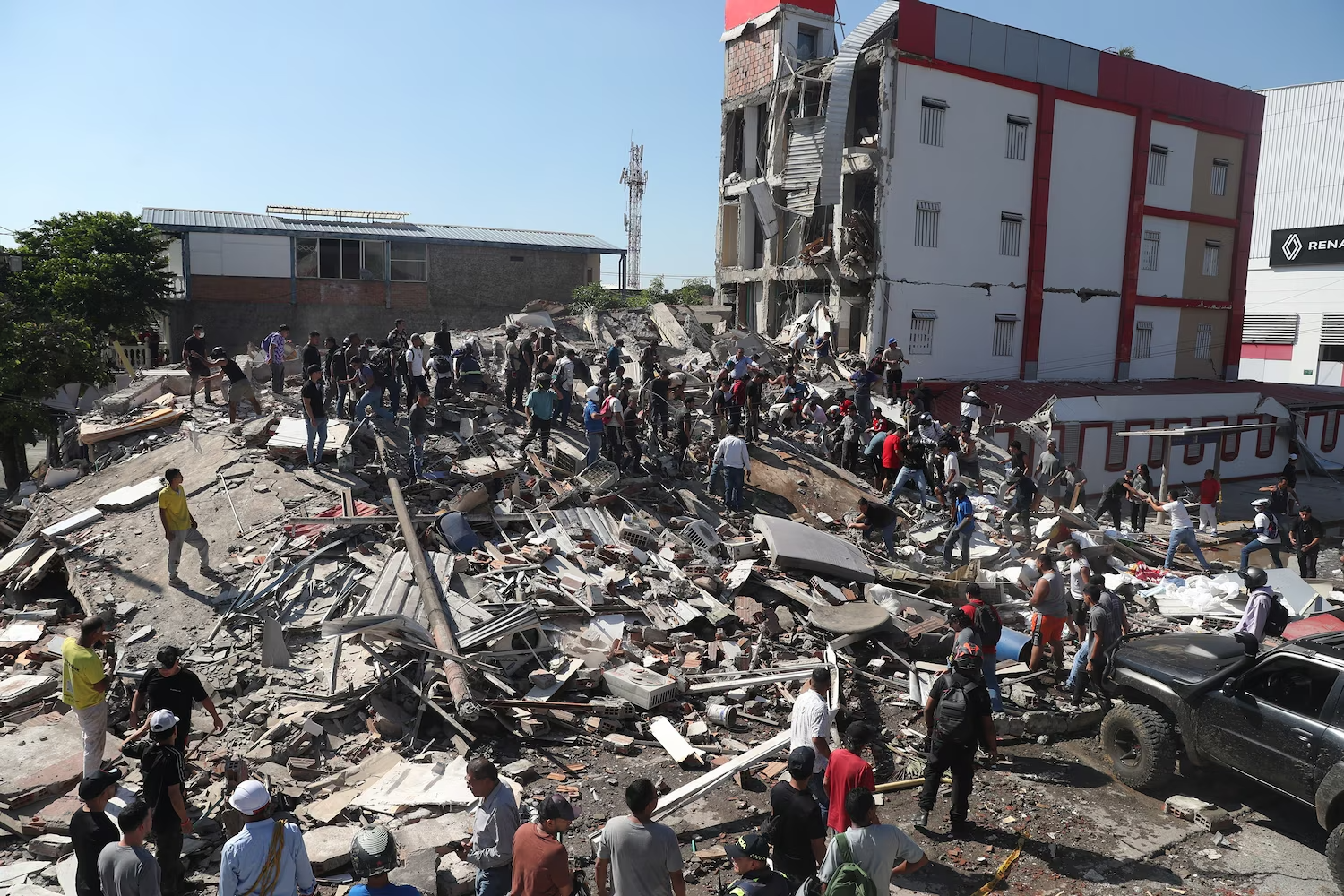
Residents and rescue workers search through the rubble of a collapsed building after an earthquake struck Cali, Colombia, Aug. 10, 2026.
Santiago Saldarriaga/AP
Colombia's people become the first responders
Despite the government's response, Colombians like Daniela Posada, a 28-year-old activist and anthropologist, has created mutual aid efforts to support survivors.
Posada organized the #ConectadosPorChocó or #UnitedForChocó, online campaign where she has helped people reconnect with family members. The campaign functions by keeping record of people in the area who have sufficient cell phone service and having them report to their neighbors the condition of their families.
“This was the way it was done, by regular people that were not part of any organization,” Posada emphasized.
Chocó was one of the areas most impacted by the earthquake, with more than 99,000 people affected or 1 in 5 people affected according to El Espectador.
Another person who has been supporting mutual aid efforts has been Blanca Jaramillo, a 62-year-old retired teacher who lives in Armenia, Quindío.
During the earthquake, Jaramillo was sheltering inside her apartment's bathroom on the 15th floor where, at some point, she thought the walls were going to crush her.
"I would describe it as if you were in a blender, because it moved from east to west and from north to south. And you can see how the structures and walls moved," Jaramillo recalled.
The panic and trauma she experienced motivated her to visit collection centers where she packaged food, clothes and other basic necessities that were sent to impacted areas.
"It's rewarding, it's satisfying," she said. "Oh, and the toys! That warmed my heart because it made me think: kids should be playing, not doing anything else."
While some Colombians find healing in helping others, Gustavo Silva Sánchez Castro said the earthquake left him with a greater sense of appreciation for life.
“It taught me to value heavenly things more, to value the spiritual more,” he said, placing his hand over his heart.
Santiago Posada-Jaramillo contributed to this report.