AVONDALE — Tuesday, Nov. 10 Dozens of Chicagoans gathered at Northeastern Illinois University’s El Centro campus Tuesday for a town hall hosted by the Illinois chapter of Make Polluters Pay, part of a nationwide movement advocating for greater accountability from fossil fuel companies for their role in the climate crisis. The Illinois coalition, which includes more than 40 environmental, community and advocacy organizations, is pushing for legislation that would require major fossil fuel companies to help cover the costs of climate change.
At the center of the coalition’s efforts is the proposed Climate Change Superfund Act, which state Sen. Graciela Guzmán (D-Ill.) and state Rep. Robyn Gabel (D-Ill.) introduced in January as Senate Bill 2981 and House Bill 4773. The legislation would require major fossil fuel companies to contribute to a dedicated state fund, with at least 40% of the money directed toward communities disproportionately affected by climate change.
Modeled after similar, successful legislation in New York and Vermont, the bills failed to advance during the 2026 legislative session. Guzmán told attendees she plans to reintroduce the legislation in early 2027.
“We’re talking about protecting homes, about strengthening infrastructure, about making sure that our communities have the resources to prepare for what’s coming,” Guzmán said. “Fundamentally, you create harm; you should be responsible for addressing it.”
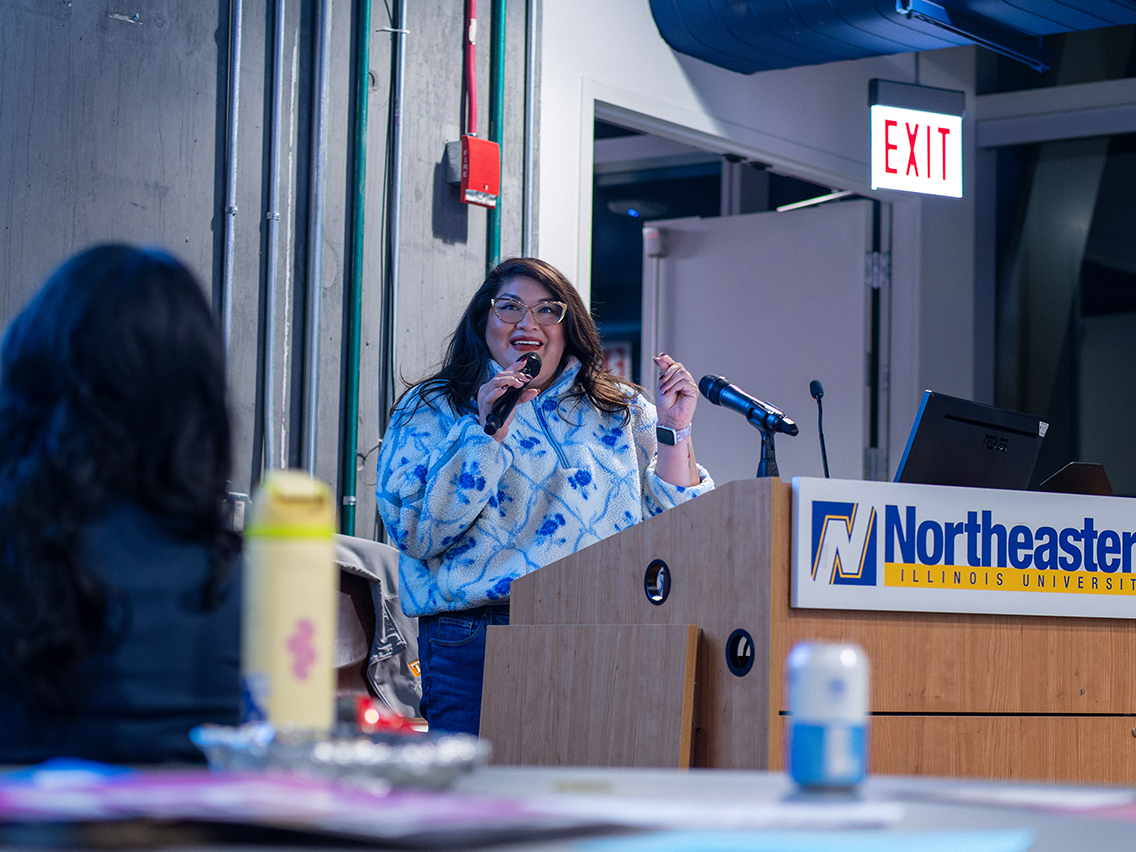
Guzmán spoke at Tuesday’s town hall, emphasizing economic and environmental benefits of the legislation.
Credit: Aireus Robinson / BIYA BIYA Productions
Representatives from the Illinois Environmental Council, National Resource Defense Council and ONE Northside, a grassroots organization that advocates for racial, social and economic justice through community organizing, emphasized the bill’s economic impacts for residents of Cook County and beyond. Under the proposed legislation, the Illinois Environmental Protection Agency would establish rules governing how payments are determined and how money from the fund could be spent. Eligible projects could include flood protection, cooling centers, and improvements to roads, bridges and schools.
Deputy organizing director of ONE Northside Seri Lee, who also serves on the MPP leadership team, highlighted what they described as an imbalance in who bears the financial burden of environmental damage.
“We are the ones who are paying for the price of climate change. In our flooded basements, our medical bills, our utility bills, our rents. Meanwhile, the fossil fuel companies that knowingly caused this crisis are making record profits,” Lee said.
In August, NPR Illinois reported in an interview with state climatologist Trent Ford that 2026 was one of the “busiest years on record for severe weather in Illinois.” Over 200 tornadoes have touched down in the state this year, up from an annual average of 66. Ford also said that more than 1,300 thunderstorm and tornado warnings have been issued in Illinois this year.
That same month, a series of severe storms swept across the Midwest, triggering thousands of power outages, flash flooding and tornadoes, as well as several hospitalizations and deaths. Meteorologists attributed the destruction to a derecho, a long-lasting thunderstorm system that often produces destructive winds and can be so powerful that derechos are sometimes called “inland hurricanes.” Although scientists cannot establish a direct link between climate change and individual derechos, research has found connections between climate change and the frequency and intensity of these storms.
As Illinois experiences increasingly costly and destructive weather events, the state’s greenhouse gas emissions remain a significant part of the climate conversation. According to the Illinois EPA 2025 Annual Greenhouse Gas Emissions Report, regulated units under Illinois’ Climate and Equitable Jobs Act emitted 49,967,796 short tons of CO2e, largely from coal and natural gas. That’s roughly 100 billion pounds of heat-trapping gases, equivalent to the annual emissions of about 10 million gas-powered cars.
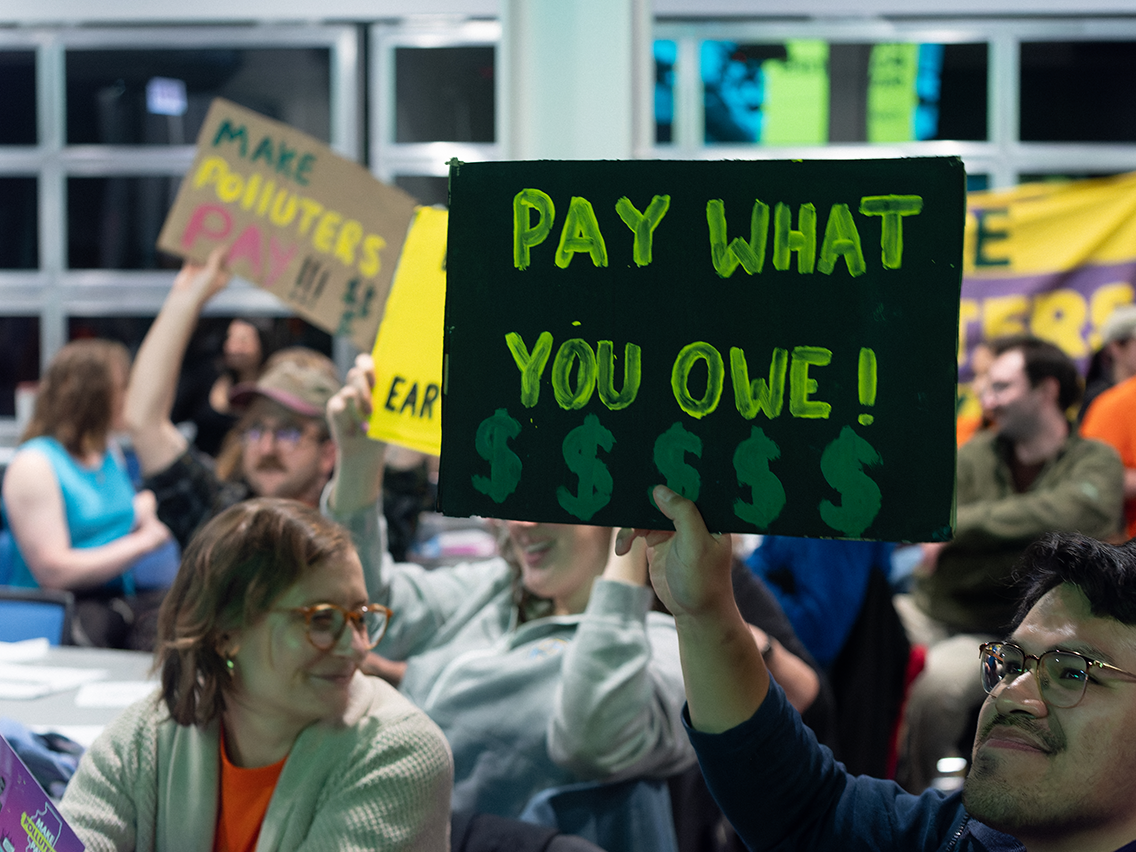
Attendees at Tuesday’s event were encouraged to participate in roundtable discussions detailing their own experiences with climate change and environmental concerns in their communities.
Credit: Aireus Robinson / BIYA BIYA Productions
Advocates at Tuesday’s town hall called for greater accountability from the fossil fuel industry and outlined efforts to advance legislation in Springfield. Following sweeping Democratic victories in the midterm Nov. 3 elections, Illinois Democrats expanded their already sizable supermajorities in both chambers of the General Assembly, while the party made significant gains nationwide. Guzmán and other advocates at the meeting said these gains provide new momentum for progressive policies.
“This movement means so much to people, even beyond the legislative and policy. I think people are really, really inspired, especially post-election, that their voice matters, their power matters, and I think they’re ready to put some pressure behind that,” said Cate Caldwell, senior policy manager at the IEC.
But passing the legislation will require more than support from lawmakers. Environmental leaders want residents of environmental justice communities to help shape the movement and inform the state’s response to climate change.
“It’s really crucial that we have this coming from the bottom up, that it’s really informed by grassroots groups, because we know that environmental justice communities are impacted first and worst by climate change,” said Gina Ramirez, director of Midwest Environmental Health at the NRDC, which helped draft the legislation.
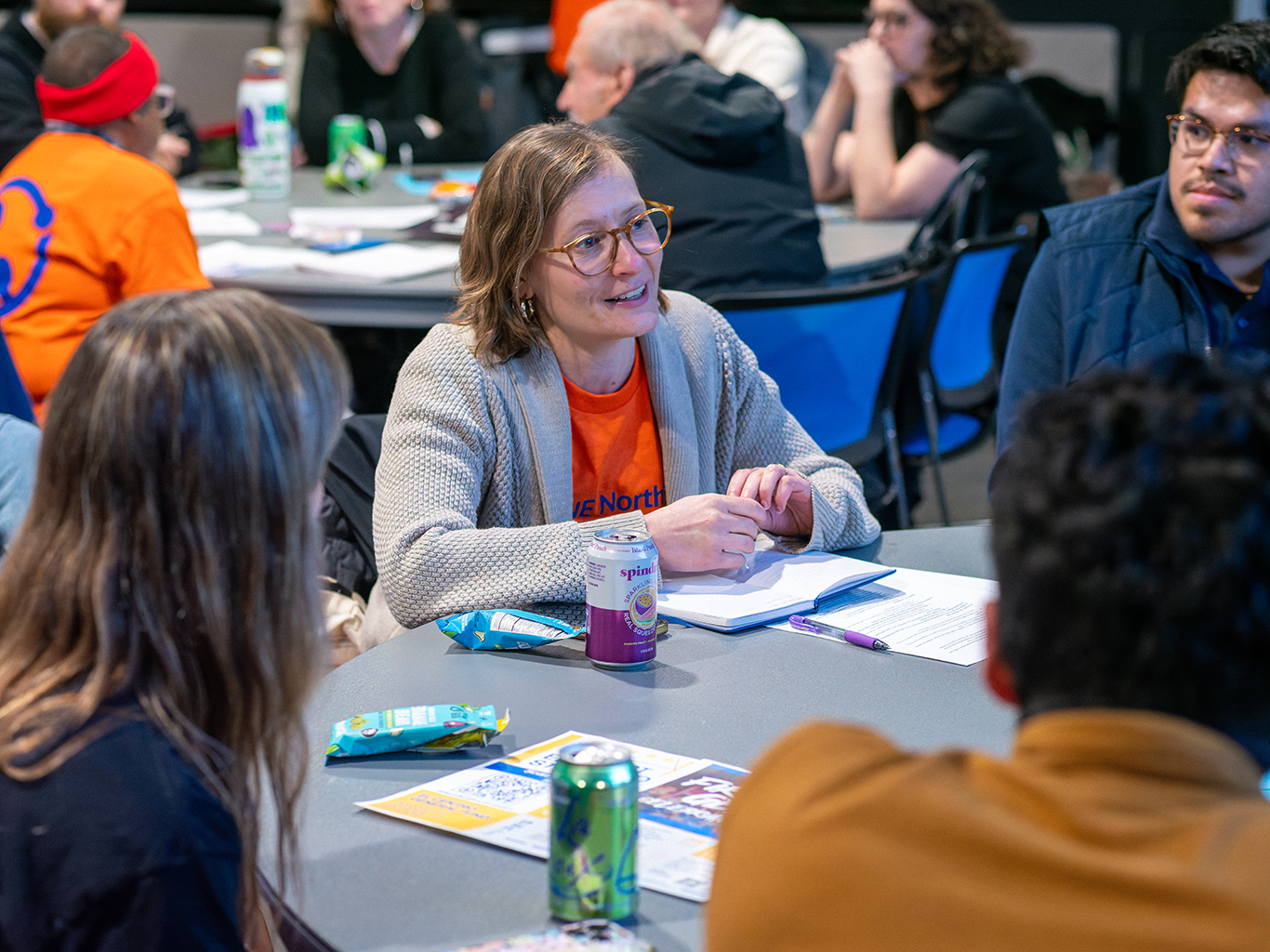
Uptown resident and ONE Northside volunteer Jess Rudnick discusses climate concerns during a roundtable exercise.
Credit: Aireus Robinson / BIYA BIYA Productions
For residents in communities already experiencing the effects of climate change, that urgency is especially personal. Uptown resident and ONE Northside volunteer Jess Rudnick said she moved to Chicago from Northern California, in part, to escape wildfires. Now, she worries about the growing threat of flooding in her own neighborhood.
Organizers said ensuring residents have a voice in shaping the legislation will be critical as the coalition prepares to bring the bill back to Springfield in 2027. They hope continued community engagement will help lawmakers understand the immediate stakes of delaying action and the need to prioritize the most vulnerable communities.
“The climate crisis isn’t waiting for a more convenient legislative calendar in Springfield,” Guzmán said. “Our communities are not waiting for another disaster to come to our office or to talk to you about what they believe needs to happen. And another generation isn’t going to wait to calculate the cost of the damage of things after it happens. We have the opportunity to deliver on something different.”